
 UKR
UKR RU
RU SK
SK


The manufacture of facade tiles is essential for obtaining a high-quality product that is resistant to negative influences. Poly-facades are popular due to a simple installation method and minimal manufacturing costs. This process has its own characteristics, which endows the tiles with maximum efficiency indicators.
What Features Does the Production of Decorative Artificial Stone Provide?
A poly-facade is a decorative tile. It can imitate various stone or brick options and also provides reliable thermal and sound insulation. The production technology of artificial decorative stone involves the creation of a two-layer structure.
- The first layer serves as the base. Its thickness ranges from 3.5 to 10 centimeters. It is made of basalt wool compressed under high pressure. Elements using polystyrene can also be found.
- The second layer represents the decorative component. White cement and sand are used as the main elements here. Polymer components are mixed into the composition to increase strength. Additionally, fiber is used for reinforcement. The thickness of this layer does not exceed two centimeters.
All these components make it possible to obtain a high-quality product. The slabs are easily installed and can be painted or decorated as desired. Also, this product can be made independently using the facade tile manufacturing technology.
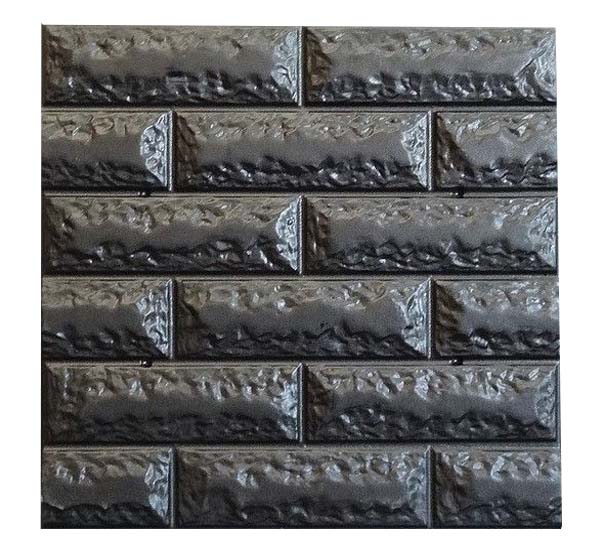
Stages of Production for DIY Implementation
The production of this finishing material can be implemented at home. For this, you need to buy poly-facade molds. Additionally, you will need a sheet of polystyrene foam with a thickness of 2.5 to 5 centimeters, sand, M500 grade cement, fiber, and concrete plasticizers. To understand how to make facade tiles, you need to look at the stages of their production.
- First, a sand-cement mixture is prepared in a one-to-two ratio. Additionally, plasticizers to improve the quality of the mixture and fiber are necessarily added to the composition. All proportions must be observed and are usually indicated on the packaging by the manufacturer.
- The composition is poured into the mold. The layer thickness should not exceed 2 centimeters.
- During the curing process of the mortar, the polystyrene foam is prepared. Its size is adjusted to the dimensions of the future product.
- Then the slab is pressed tightly against the not-yet-hardened mortar and weighed down from above with a load.
After drying, the finished slabs are removed from the mold. This is the final version, and it is ready for the installation process.
In our "Budprom" store, you can buy plastic molds for concrete products at an attractive price. Also, with us, you can find all the necessary auxiliary equipment for creating high-quality concrete. All our goods have high quality and reliability in application.
27/09/2021