
 UKR
UKR RU
RU SK
SK


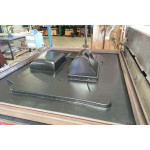
Thermal vacuum forming is a process in which sheet plastic, particularly
ABS plastic, is heated to a plastic state and then, under the influence of a
vacuum, takes the shape of a matrix or template. This technology is widely used
in various industries, including the production of molds for concrete products.
Thermal vacuum forming allows you to obtain high-quality, durable and
economical molds that are ideal for the manufacture of fences, paving slabs and
other concrete products.
The working principle of thermal vacuum forming
The process of thermal vacuum forming includes several stages:
- Preparing
plasticA sheet of ABS plastic is loaded into a special machine and heated
to a certain temperature at which it becomes flexible but does not melt.
- Molding. After heating,
the plastic is placed over a matrix or template. A vacuum pulls air out
from under the plastic, causing it to fit tightly to the mold and follow
its contours.
- Cooling. Once the
plastic has taken the desired shape, it is cooled to fix the result.
Cooling can occur naturally or with the use of air or water.
- Trimming and
finishing. Once the plastic has hardened, excess material is trimmed off and
the finished product is removed from the mold. Additional modifications may also be made at
this stage.
Advantages of Thermo-Vacuum Forming in ABS Mold Production
The production of forms for concrete products using thermal vacuum
forming technology has several significant advantages:
- Economy. The
process of thermal vacuum forming requires less material and energy
compared to other methods of producing plastic products. This allows to reduce the cost of finished
products.
- Precision
and detail. Forms made using vacuum forming are
characterized by high precision and clarity of details. This is especially
important in the production of decorative elements for concrete fences,
tiles and other products.
- Flexibility
and versatility. The technology allows for the production of
moulds for products of varying complexity and size. This gives
manufacturers flexibility in developing new products and adapting them to
customer needs.
- Strength and
durability. ABS plastic molds created by the method of
thermal vacuum molding have high strength and wear resistance. They can be
repeatedly used in the production of concrete products, maintaining their
properties for a long time.
- Fast
productionVacuum forming is a relatively fast process,
allowing for rapid production of molds to meet large orders. Reducing production time also reduces
manufacturing costs.
Thermo-vacuum forming is an important technology in the production of
ABS plastic molds for concrete products. It allows for the creation of precise,
durable and cost-effective molds, ensuring high quality of the final product.
This technology is widely used in the construction industry and allows
manufacturers to be flexible, competitive and respond quickly to customer
needs.
24/09/2024