
 UKR
UKR RU
RU SK
SK


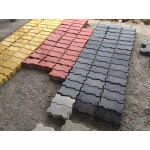
The production of paving tiles requires the use of quality moulds that
can ensure the durability and aesthetic appeal of the finished product. One of
the key aspects in this process is the choice of technology and materials for
the manufacture of moulds.
1. technologies for production of paving slab moulds
1.1 Injection moulding
One of the most common technologies for the production of paving slab
moulds is injection moulding. This method allows the creation of moulds with a
high degree of precision and detail, which is especially important for complex
and decorative tile elements. Injection moulding ensures an even distribution
of material, which makes the mould strong and durable.
1.2 Thermoforming
Thermoforming is a technique in which a sheet of ABS plastic is heated
to a certain temperature, after which it is moulded into the desired shape
under vacuum or pressure. This method allows the production of moulds with
different wall thicknesses, making them versatile for different types of tiles.
1.3. 3D printing
With the development of additive technologies, 3D printing is becoming
increasingly popular in the production of paving slab moulds. This method makes
it possible to create prototypes and small series of moulds with high precision
and minimal production costs. 3D printing also provides the ability to quickly
change mould designs, making it a particularly attractive method for companies
looking for flexibility in their production processes.
2. Materials for the production of moulds
2.1. ABS plastic
ABS plastic (acrylonitrile butadiene styrene) is one of the most popular
materials for manufacturing paving slab moulds. It has high strength,
resistance to aggressive media and good shock absorption properties. ABS
plastic is easy to process, making it ideal for injection moulding and
thermoforming.
2.2 Polypropylene
Polypropylene is also used in the production of paving moulds, although
less frequently than ABS plastic. This material is characterised by high
chemical resistance and low density, which makes it lightweight and easy to
process. However, polypropylene moulds are less durable than ABS plastic, so
their use is limited.
2.3 Polyurethane
Polyurethane is used to create more flexible moulds, which are necessary
for the production of tiles with complex geometries or decorative elements.
This material is highly resistant to wear and tear and UV radiation, making it
ideal for long-term use. However, its cost is higher than ABS plastic, which
increases production costs.
3. Advantages of using ABS plastic
The choice of material for the production of moulds affects the final
quality of the paving slabs. ABS plastic is a leading material due to its
unique properties. It provides:
- Durability
and wear resistance: ABS plastic moulds can withstand many concrete
pouring cycles while retaining their original characteristics.
- High surface
quality: paving tiles made with ABS plastic moulds have a smooth and even
surface, which improves their appearance.
- Cost-effective: due to its
availability and ease of processing, ABS plastic reduces mould production
costs.
26/08/2024